
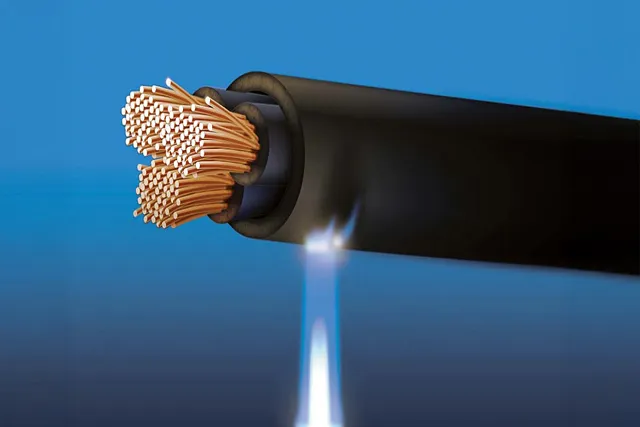
Fire resistant intended for use in flame circumstances where the spread of blazes along a cable course should be impeded. fire retardants are intended to back off the spread of flame. as copper does not liquefy effectively except if the wires are short or grounded they keep on passing current. some have a higher imperviousness to fire and some have a low imperviousness to fire. if you don’t mind be more particular .Fire retardant cables can discharge less harmful smoke and difficult to flame, so they can give individuals more opportunity to left the perilous region or stay away from the blast. These cables focus on security of human life.
Fire hindering properties in cable are of extraordinary significance. To make it less complex to comprehend, will take case of ‘Flame triangle’. It has got three sides ‘Oxygen (Air), Fuel (Flammable material) and Heat (Source of flame)’. On the off chance that anybody of the segment is missing, fire or fire won’t engender itself nor will it spread.
For influencing the cable safe from flame, we to enhance the properties of cable coat and attempt and guarantee self-dousing mixes, which regardless of whether there is outside flame, they won’t engender the flares.
In fact it is described as beneath:
External coat of the cables are of fire resistant material just, which doesn’t permit fire proliferation. It is estimated according to IS 10810 Part 53 or IEC 60332 Part 1.
In the air typical Oxygen rate is 21 percent, we enhance the cables Oxygen file to a level of 30 to 35 percent. Means in the standard barometrical condition till the level of oxygen achieves 30 to 35 percent; cable won’t go about as fuel. It is estimated according to IS 10810 Part 58 or ASTM D 2863.
This condition can be additionally looked from changed edge i.e. on the off chance that wellspring of flame (warm) is more than at 21 percent additionally cable can go about as fuel. For such condition temperature list is estimated, or, in other words the scope of 250 to 350 °C. In this manner till such high temperatures cables don’t go about as fuel. It is estimated according to IS 10810 Part 64 or ASTM D 2863.
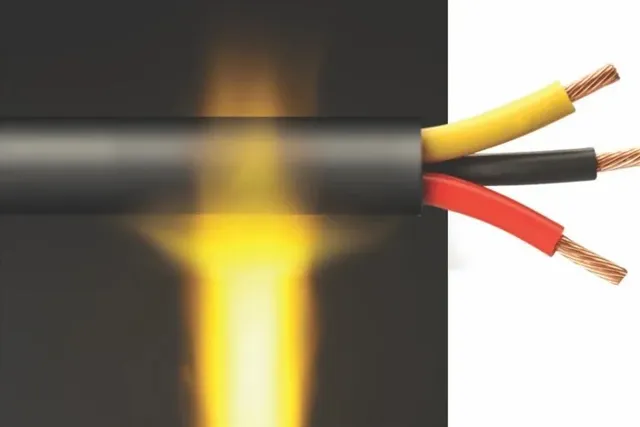
Fire retardant cables are the ones that can resist fire. They are chemically treated to self extinguish. Even if the intensity of fire continues for a longer time then it can resist the spread of fire. These are basically designed to encounter situations where there is a need to retard the spread of fire along a cable route. They are more preferred because of their low cost and more often used to maintain circuit consistency of safety systems. For example fire alarms.
Ordinary flame retarded cables – These cables when exposed to fire emit corrosive gases and combustion.
Low halogen fire retardant cables – These emit low halogen acid gas and less corrosive and smoke after combustion
Low smoke zero halogen fire retardant cables – These are even better emitting no halogen acid gas, less corrosive gas and very less fuming. It possesses excellent fire retardant property. These are widely used in nuclear power plants, subway stations, telephone switching and computer control centers, high-rise buildings, hotels, radio and television stations, important military facilities, oil platforms, etc. Both the above categories maintain the mechanical, electrical and physical properties to meet operating requirements of the cable.
Oxygen Barrier Cable – These are also known as highly flame retardant cables. A layer of non-softening, non-combustible, halogen-free, smoke-free, heatproof plastic material is filled or wrapped between the cable protected center and the cable sheath, i.e. insulating natural is utilized to confine the cable from the outside oxygen gas, with the goal that the cable is non-flammable or flame retardant. It is advisable to prefer the last three depending upon their cost as the burning of ordinary fire retardant cables may lead to emission of hazardous gaslike chlorine gas that is poisonous and is dangerous for human beings. This forms hydrochloric acid if comes in contact with water can further deteriorate the problem as it can have a destructible effect on the adjacent equipment. Zero halogen and oxygen barrier cables have better fire retardant properties, low toxic and corrosive gas emissions, and low smoke emission.
Znergy is an Australian-based cable engineering and manufacturing group supplying power cable solutions to mining, infrastructure, and industrial markets
© 2026 All Rights Reserved by Znergy Cable | Designed By FODUU
