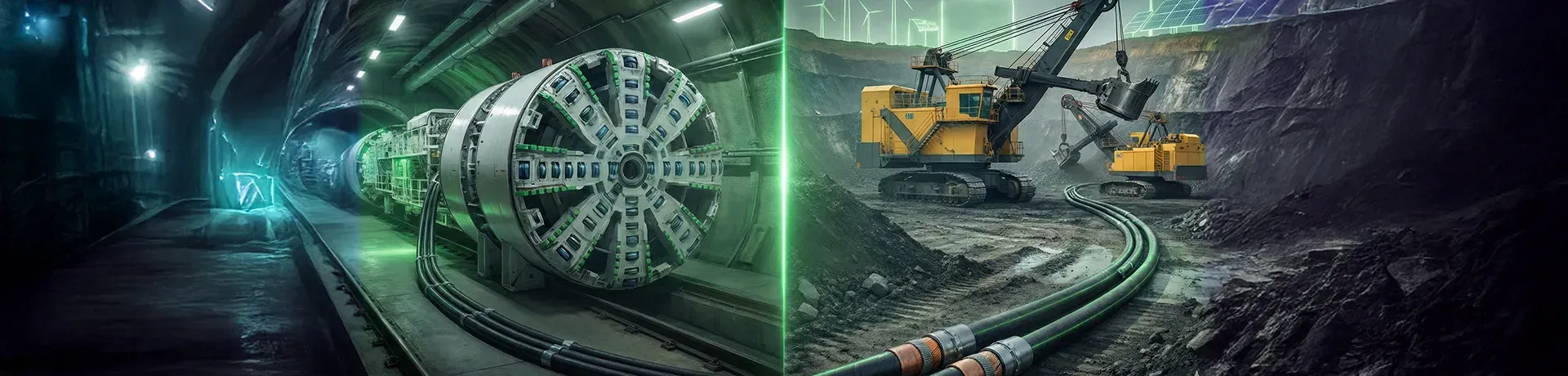
Designed for light to medium duty trailing applications where flexibility and flame retardance are critical. Type 209 cables are commonly used for portable and semi-mobile underground equipment where frequent movement occurs.
Znergy Type 209 cables are engineered with controlled conductor stranding and insulation systems selected to tolerate repeated flex cycles. Pilot core construction is stabilised to reduce fatigue-related failures, and sheath compounds are selected for improved abrasion resistance within the limits of flexible construction.
USE WHEN: Frequent movement, moderate mechanical stress, high flexibility required.
DO NOT USE WHEN: Sustained heavy dragging, high crush risk, or severe abrasion dominates.
Znergy's Type 209 is a premium flexible power cable engineered for the demanding environments of mining and heavy industry. Rated from 1.1/1.1 kV up to 11/11 kV, this cable is purpose-built for feeder connections between transformers and gate-end boxes, as well as power distribution to pumps, fans, crushers, and similar high-load equipment.
Where Type A or B feeder cables are typically specified, the Type 209 serves as a direct and fully compliant substitute — offering equivalent or superior performance with enhanced flexibility and resilience. It is equally suited to above-ground applications, including power supply to mobile and relocatable equipment.
The Type 209 is manufactured and tested in full compliance with the following Australian and New Zealand standards:
|
Property |
Specification |
|---|---|
|
Voltage Range |
1.1/1.1 kV to 11/11 kV |
|
Conductor Material |
Stranded copper (flexible class) |
|
Conductor Configuration |
3 core + earth, available in multiple CSA |
|
Voltage Test (11 kV) |
28 kV AC for 5 minutes |
|
Insulation Type |
EPDM / EPR (Ethylene Propylene Rubber) |
|
Property |
Specification |
|---|---|
|
Flexibility |
High flexibility — suitable for repeated flexing and reeling |
|
Mechanical Impact Resistance |
Heavy duty — rated for severe mechanical stress
environments |
|
Jacket Material |
Heavy-duty CSP (Chlorosulfonated Polyethylene) or
equivalent |
|
Flame Performance |
Fire retardant — self-extinguishing per AS/NZS standards |
|
Minimum Bending Radius |
6× overall cable diameter (static); 8× (dynamic/reeling) |
|
Property |
Specification |
|---|---|
|
Chemical Exposure |
Very Good / Suitable for frequent exposure to oils, hydraulic
fluids, and mining chemicals |
|
Water Exposure |
Immersion rated — temporary submersion and water
coverage |
|
Solar & UV Radiation |
Suitable for direct outdoor exposure — UV stabilised outer
sheath |
|
Abrasion Resistance |
Heavy duty — designed for trailing, dragging, and ground
contact |
|
Ozone & Weather Resistance |
Excellent — EPR/CSP construction resists cracking and
degradation |
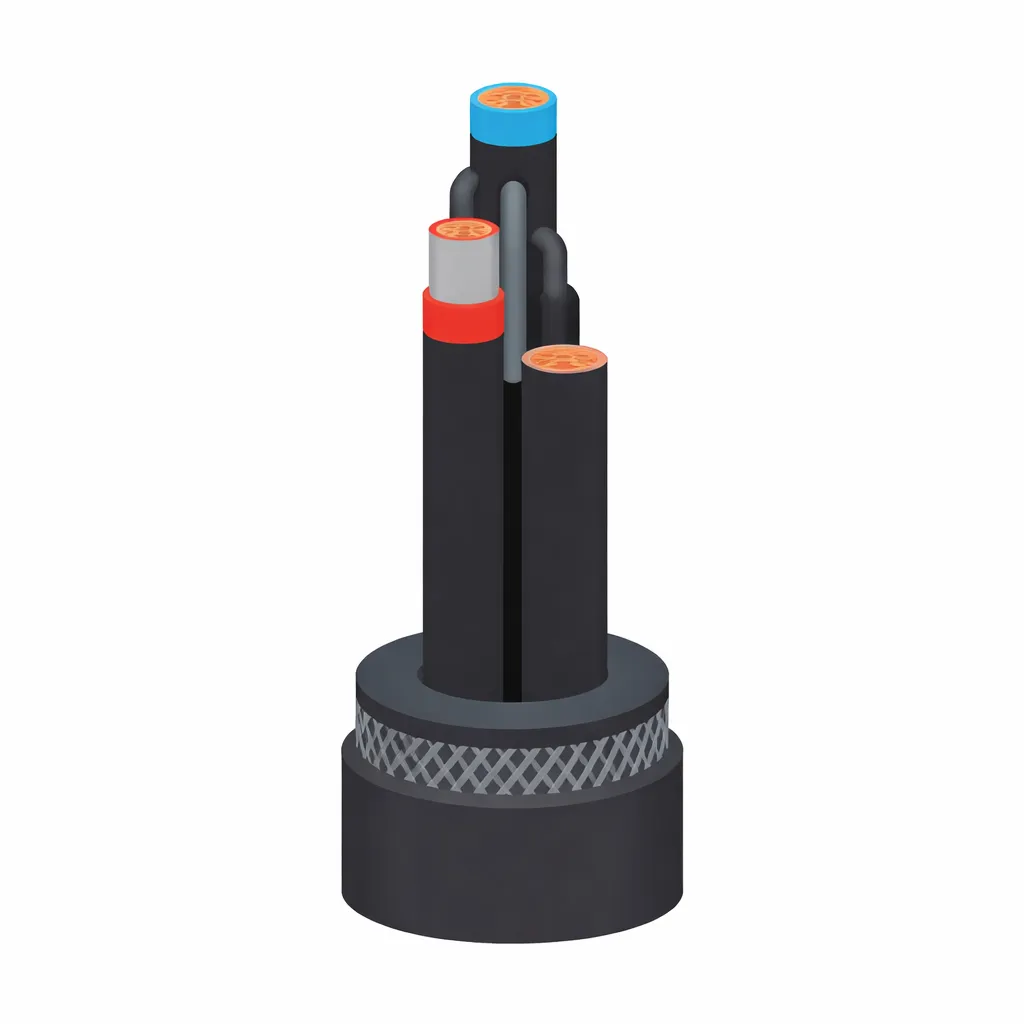
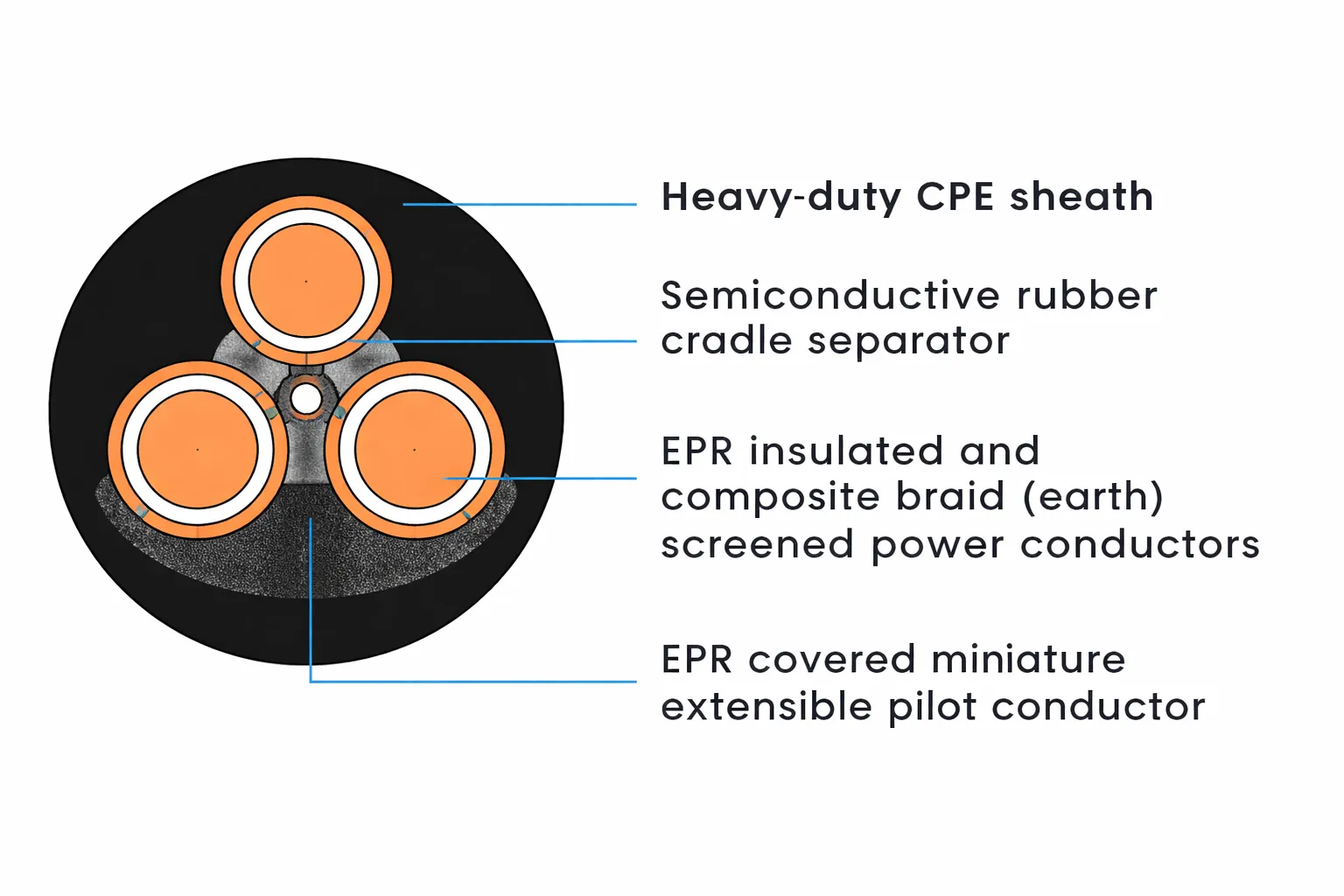
Composite screened cores with a single extensible pilot.
Core: Metal: tinned copper, three core plus central pilot.
Conductor separator tape: 1.1/1.1 kV – polyester. 3.3 kV and above – semiconductive tape.
Insulation: EPR (R-EP-90).
Insulation tape: 1.1/1.1 kV – proofed textile. 3.3 kV and above – semiconductive screen.
Screen: Composite screen (earth) of tinned annealed copper wire and polyester yarn. Core colours: red, white, blue braid tracers.
Pilot: Single, in centre of cable. Maximum DC resistance; 5.5 Ω/100m for power cores to 35mm2. 3 Ω/100m for power conductors above 35mm2.
Sheath: Heavy duty HD-85-PCP Sheath reinforcement is available upon request.
Common failure modes in misapplied Type 209 cables include insulation fatigue from excessive mechanical loading, pilot core breakage due to tight bend radii, and premature sheath wear where abrasion is underestimated.
|
Property |
Specification |
|---|---|
|
Maximum Operating
Temperature |
+90°C (conductor) |
|
Minimum Operating
Temperature |
Temperature-25°C (installation and operation) |
|
Short-Circuit
Temperature |
Up to +250°C (short duration) |
Znergy is an Australian-based cable engineering and manufacturing group supplying power cable solutions to mining, infrastructure, and industrial markets
© 2026 All Rights Reserved by Znergy Cable | Designed By FODUU