Type 2S cables are EPR insulated, composite screened, CPE sheathed underground mine cables designed for specialised applications where additional screening integrity, earthing continuity, or protection is required beyond standard Type 241 constructions. Available in individually screened (IS) and collectively screened (CS) configurations across multiple core counts and voltage ratings.
Common failure modes arise when Type 2S constructions are substituted without understanding their specific screening system and application intent, or when core count and pilot configuration are incorrectly matched to the protection relay scheme.
Znergy applies Type 2S constructions selectively, ensuring the electrical design, screening system, core configuration, and mechanical properties are precisely matched to the intended duty, protection philosophy, and relay coordination requirements of the circuit.
USE WHEN: Specialised screening, earthing integrity, multi-core control, or individually screened power cores are required.
DO NOT USE WHEN: Simpler constructions adequately meet the duty and compliance requirements.
AS/NZS 1802
AS/NZS 1972
AS/NZS 1125
AS/NZS 3808
IS — Individually Screened Composite tinned copper wire & polyester yarn braid screen applied to each power core. Pilot core also screened when power cores are individually screened.
CS — Collectively Screened Single composite screen applied over the complete assembled core group. Used for specialised low-voltage multi-core applications.
Flame retardant per IEC 60332-1-2. HD-90-CPE sheath is UV resistant and oil resistant per IEC 60811-404. Ozone resistant per IEC 60811-403.
Machine cable duty — flexible EPR and Class 5 conductor allow regular repositioning. Not designed for continuous drum reeling. Min. bending radius: 6× cable OD.
|
Chemical / Oil exposure |
Very good — HD-90-CPE sheath |
|
UV & weather |
Excellent — UV stabilised CPE |
|
Ozone |
Excellent — per IEC 60811-403 |
|
Flame |
Retardant — per IEC 60332-1-2 |
|
Water exposure |
Immersion / Temporary coverage |
The IS construction screens each power core individually with a composite tinned Cu wire and polyester yarn braid —enabling per-phase earth fault detection required by most AS/NZS 1802 protection relay schemes. The pilot core is also individually screened, maintaining relay signal integrity under adjacent power core interference.
The CS construction applies a single collective screen over the assembled group — providing general shielding and EMI control for multi-core monitoring circuits where per-phase screening continuity is not required by the protection scheme.
IS (1.1 kV): Per-phase earth fault monitoring; 2C, 3C, or 4C with or without pilot.
IS (3.3 kV): Screened 3C trailing or fixed duty — confirm OD against coupler bore (larger ti = larger cable).
CS (1.1 kV): SCADA, telemetry, interlock, signalling —2 to 30 cores, 1.5 mm2
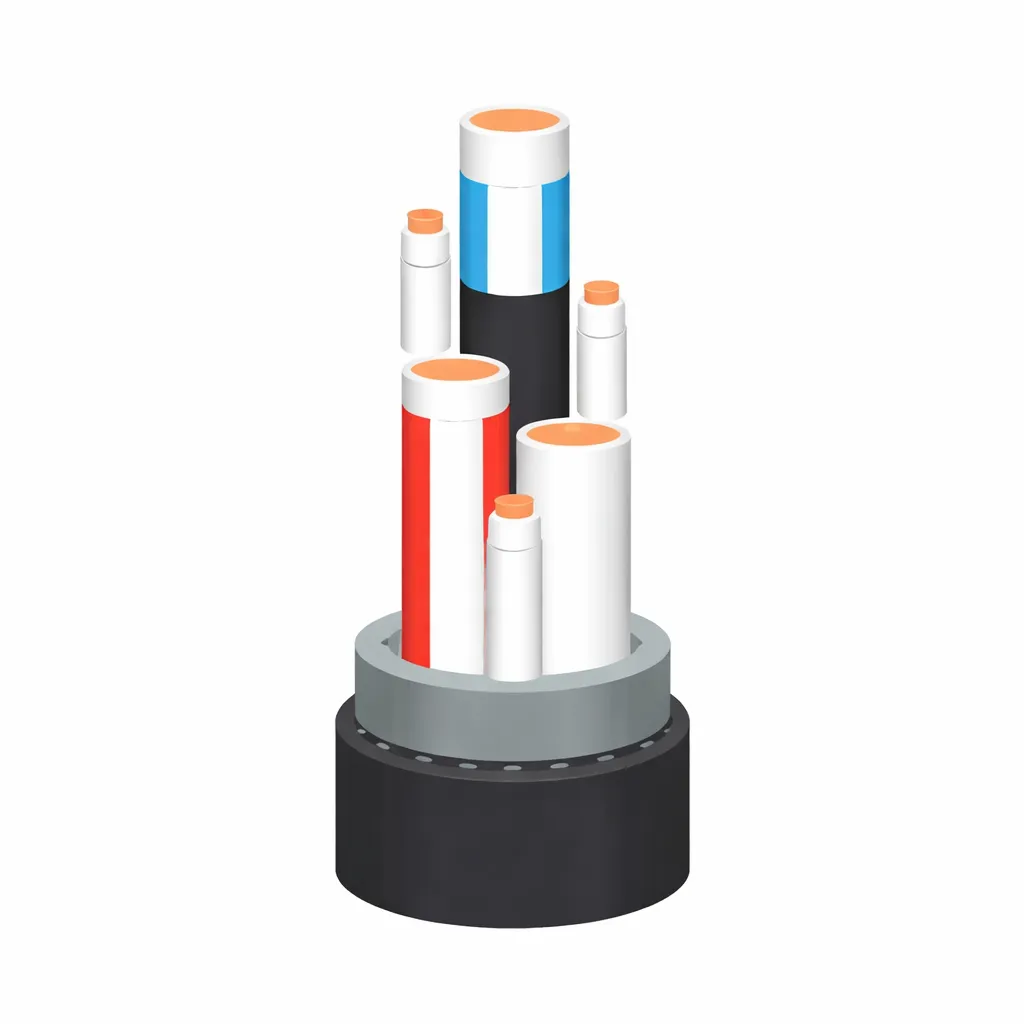
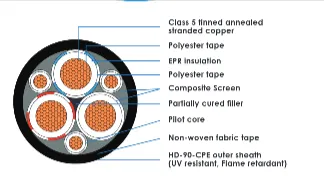
EPR insulated, composite screened, CPE sheathed cable. Available in IS (individually screened) or CS (collectively screened) variants across 2–30 core configurations.
Core: Class 5 tinned annealed Cu (AS/NZS 1125). Power cores: Red, White, Blue. Earth cores: Black. Pilot: Grey.
Insulation: EPR (R-EP-90). Polyester tape over conductor before and after EPR.
Screen (IS): Composite tinned Cu wire and polyester yarn braid —applied individually per power core. Pilot also screened.
Screen (CS): Single composite screen over complete assembled core group.
Pilot (IS): Tinned annealed Cu, R-EP-90 insulated, individually screened.
Filler: Partially cured filler — circular or near-triangular.
Binder: Non-woven fabric tape over assembled group.
Sheath: HD-90-CPE (Black) — UV resistant, oil resistant, flame retardant.
|
Variant |
Cores |
Voltage |
Pilot |
|---|---|---|---|
|
IS — Individually Screened |
2C, 3C, 4C |
1.1/1.1 kV |
Optional |
|
IS — Individually Screened |
3C |
3.3/3.3 kV |
1P standard |
|
CS — Collectively Screened |
2–30 cores |
1.1/1.1 kV |
None |
|
Property |
Specification |
|---|---|
|
Maximum Operating
Temperature |
+90°C (Conductor) |
|
Minimum Operating
Temperature |
-25°C |
|
Short-Circuit
Temperature |
Up to +250°C (5 s) |
|
Emergency Rating |
+130°C |
Znergy is an Australian-based cable engineering and manufacturing group supplying power cable solutions to mining, infrastructure, and industrial markets
© 2026 All Rights Reserved by Znergy Cable | Designed By FODUU